

Mapping India’s trade remedy regime: Empirical trends and insights from March 2026
Pareesha Gupta
PartnerAbhishek Tripathi
AssociateIntroduction
Trade remedy measures, namely anti-dumping (‘AD’), countervailing duty (‘CVD’) and safeguard duty, have become central policy instruments for countries seeking to shield domestic industry from unfair pricing practices, market distortions or sudden import surges. In the Indian context, this regime is administered by the Directorate General of Trade Remedies (‘DGTR’) under the Ministry of Commerce (‘MoC’), which conducts the investigations, while the Ministry of Finance (‘MoF’) decides whether to imposes duties after reviewing the DGTR’s recommendations. However, in case of safeguard action which covers only quotas or quantitative restrictions (without involving any duty element), the task of investigation and imposition are both undertaken by the departments under the MoC.
The last month of Indian fiscal year 2025-26 i.e. March 2026 (‘month’) witnessed heightened activity with a notable number of initiations of trade remedy investigations. A total of 25 investigations were initiated during the month, reflecting both the responsiveness of the system and the continued reliance of domestic industry on trade remedies as a means of redressal for unfair trade.
This article examines recent initiations across various categories in the light of shifting trends in Indian trade remedy investigations. The article also examines empirical trends across type, nature, country and sectors targeted by these actions.
Shifting trends in Indian types of trade remedy investigations
Historically, India has been a very frequent user of AD measure as compared to other measures like CVD and safeguards. This is possibly because investigated elements in an AD investigation (export price, normal value, dumping and injury margins and injury parameters for domestic industry) are perceived to be more objective and straight forward to determine and investigate. In contrast, a CVD investigation involves subsidies granted in a foreign jurisdiction by the foreign governments or public bodies which are mostly a times difficult to find and investigate particularly in cases where the public documents are not in English language. Safeguard measures, on the other hand, are short lived particularly when it comes to the India with measures expiring in not more than 3 years in most cases. These considerations have generally dissuaded the domestic industry in India from seeking protection under the umbrella of CVD and safeguards.
However, recent spate of decisions by the MoF in not imposing the AD measures despite positive recommendations from DGTR, has made the domestic industry rethink its strategies. The trend is gradually leading to the domestic industry targeting CVD and safeguard measures wherever the MoF declined to impose the AD duties. For instance, the MoF declined to impose AD measures in 2025 on PVC suspension resin,[1] multilayer paper boards[2] and soda ash.[3] The month has therefore seen CVD investigations initiated on PVC suspension resin (initiated in February 2026) and multilayer paper boards from the same set of country(ies). For these cases, even though the final decision-making power to impose CVD is still in the hands of MoF, it appears that the domestic industry believes that the outcome may be more amicable and, in their favor, when it comes to subsidies granted by the foreign governments. In Soda ash, on the other hand, a safeguard investigation on imposing QRs was initiated by the DGTR. Because the safeguard measures (in the form of QRs) in India are both investigated and implemented by MoC, it appears that the domestic industry in the said case has more faith in the MoC to give protection rather than relying on the final decision-making veto of MoF.
In summary, the MoF veto in many AD cases, is making the long-standing trends somewhat shift in the context of Indian trade investigations, although largely the initiations in the month still lend themselves towards AD more than towards CVD and safeguards. The table below shows continued reliance of Indian domestic industry on AD cases rather than CVD and safeguards.
| S.No. | Types of Trade Remedy Investigations | Number of Cases |
| 1. | Anti-Dumping Duty Investigation | 21 |
| 2. | Countervailing Duty Investigation | 3 |
| 3. | Safeguard (Quantitative Restrictions) Investigation | 1 |

The above pie-chart reflects in percentage terms the types of trade remedy investigations initiated in the month
As evident from the above table and pie-chart, the anti-dumping investigations constitutes the dominating share and implies that dumping remains the primary concern for the domestic industry in India. In contrast, the comparatively limited number of CVD investigations indicates that while subsidisation by exporting countries is a recognised challenge, such measures are pursued selectively and in circumstances highlighted above and where the existence and impact of subsidies can be clearly demonstrated. Similarly, the single instance of a safeguard investigation reflects the targeted response to import surges, indicating that such measures are used sparingly by the domestic industry.
Nature of initiations
A more nuanced understanding emerges when the initiations are classified based on the nature of proceedings. This distinction captures whether the cases involve fresh investigations or the continuation and enforcement of existing measures.:
| S.No. | Nature of Proceedings | Number of Cases |
| 1. | Original Investigations (‘OI’) | 13 |
| 2. | Sunset Reviews (‘SSR’) | 8 |
| 3. | New Shipper Review (‘NSR’) | 1 |
| 4. | Anti-Circumvention (‘AC’) | 1 |
| 5. | Anti-Absorption (‘AA’) | 2 |

The above pie-chart reflects in percentage terms the nature of proceedings initiated in the month
As evident from the above table and pie-chart, the initiation of 13 original investigations indicates a steady filing of fresh applications by the domestic industry, pointing to the concerns of injury caused by unfair imports of newer products. At the same time, the presence of 8 sunset reviews reflects the maturing cycle of existing measures, where the DGTR is required to reassess whether the expiry of such duties would be likely to lead to the continuation or recurrence of dumping and injury, thereby warranting their continuation.
The initiation of anti-circumvention and anti-absorption proceedings, though limited in number, is particularly significant. These mechanisms are aimed at preserving the effectiveness of trade remedy measures by addressing attempts to bypass or dilute duties’ impact on the Indian producers in India. The anti-circumvention and anti-absorption initiations reflect an enhanced enforcement approach, where the focus is not only on imposing duties but also on ensuring their effectiveness during the tenure of duties.
Country-wise trends and concentration of investigations
A close review of target countries reveals a clear concentration of activity against certain exporting countries. The distribution indicates both the source of imports under review, and the strategic focus of domestic industry complaints. The table below presents a country-wise overview of the initiated investigations:
| S.No. | Countries targeted* | Number of Cases |
| 1. | China PR | 15 |
| 2. | Thailand | 3 |
| 3. | Russia | 3 |
| 4. | Taiwan | 3 |
| 5. | Saudi Arabia | 2 |
| 6. | Singapore | 2 |
| 7. | UAE | 2 |
| 8. | Egypt | 2 |
| 9. | South Korea | 1 |
| 10. | United States of America | 1 |
| 11. | Turkey | 1 |
| 12. | Indonesia | 1 |
| 13. | Oman | 1 |
| 14. | South Africa | 1 |
*Note: This table lists the subject countries for trade remedy investigations initiated in the month. Where a single investigation involves multiple countries, it is counted under each relevant country. For example, Acetone, exported from Singapore, South Korea, Taiwan, and Thailand, is included in all four rows.
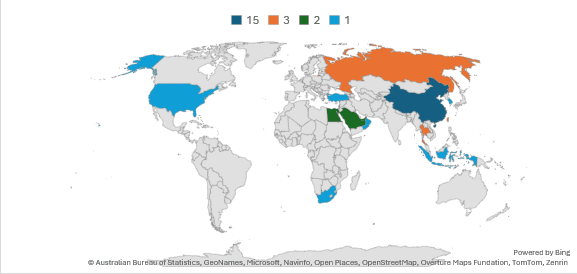
The map above highlights the country-wise trends and concentration of trade remedy investigations initiated in the month
The above distribution shows that a substantial portion of trade remedy activity is focused on few key exporting countries. China PR continues to be the most frequently involved country, reflecting both its significant share in global supply chains for industrial and chemical products and the concerns raised by the Indian producers in India regarding dumping and subsidisation. Other countries, such as Thailand, Russia, and Taiwan, also appear frequently, highlighting that trade remedy measures address imports from multiple regions rather than a single source. Additionally, several investigations cover multiple exporting countries simultaneously, underscoring the interconnected and complex nature of global trade flows.
Sectoral distribution and key trends
An examination of the products targeted reveals a clear sectoral pattern. This distribution highlights the sectors most affected and provides further insight into the focus of domestic industry concerns. The table below presents the sectoral breakdown of the investigations initiated during the month:
| S.No. | Sector | Number of Cases |
| 1. | Chemicals and Petrochemicals | 15 |
| 2. | Metals and Industrial Materials | 4 |
| 3. | Construction and Packaging Inputs | 2 |
| 4. | Specialty and Industrial Components | 4 |
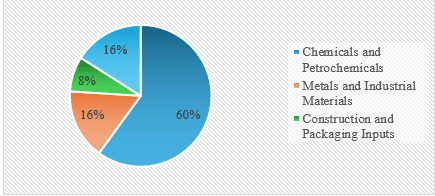
The above pie-chart provides a percentage-wise overview of the sectoral focus of trade remedy investigations initiated in the month
As evident from the above table and pie-chart, the distribution indicates that the investigations are predominantly concentrated in a few key industrial segments, with chemicals and core industrial inputs accounting for a significant proportion, alongside more targeted actions in construction-related materials and specialised components. The trends across these sectors are further discussed below.
Chemicals and Petrochemicals Sector (Dominant)
A substantial majority of the investigations pertain to the chemicals and petrochemicals sector, covering a diverse range of products including industrial chemicals, intermediates, solvents, agrochemical inputs and specialty compounds used across multiple downstream industries.[4] The inclusion of both basic and specialised chemicals reflects the integrated nature of the sector, where pricing distortions at one stage can affect the broader value chain. Accounting for more than half of the total initiations, this sector continues to witness sustained trade remedy activity, indicating persistent concerns relating to dumping and subsidisation, particularly from key exporting countries.
Metals and Industrial Materials
The data also reflects a steady presence of investigations in metals and industrial materials. The metals and industrial materials segment comprise investigations relating to primary and intermediate inputs such as aluminium products, steel tubes and other essential materials integral to manufacturing and infrastructure.[5] The pattern of initiations within this sector, coupled with the presence of review proceedings alongside fresh investigations, reflects sustained competitive pressures driven by global supply dynamics.
Construction and Packaging
Investigations within the construction and packaging segment relate to materials widely used in infrastructure development and industrial packaging applications.[6] These include building materials and paper-based inputs. The initiation of both anti-dumping and countervailing proceedings in this sector points to concern relating to both unfair pricing and subsidisation. This reflects the sensitivity of such industries to import-induced price distortions.
Specialty and Industrial Components
The remaining investigations fall within the category of specialty and industrial components, comprising niche products with specific industrial applications, including components used in transportation and specialised manufacturing processes.[7] Although limited in number, these cases reflect targeted intervention in specialised segments where domestic producers may face heightened vulnerability due to limited scale or concentrated demand. The initiation of such proceedings demonstrates the responsiveness of the trade remedy framework in addressing both broad-based and niche industry concern.
Conclusion
The investigations initiated in March 2026 reflect a robust and active trade remedy regime in India. The above analysis shows a clear pre-dominance of anti-dumping investigations, although a gradual shift towards CVD and safeguards can also be noticed particularly for commodities where MoF used its veto power to reject imposition of AD measures despite positive recommendations of DGTR. Meanwhile, the mix of original investigations, sunset reviews and specialized proceedings such as anti-circumvention and anti-absorption reviews illustrates that the DGTR also applies trade remedies judiciously to preserve the integrity and continued effectiveness of existing measures.
The sectoral and country-specific trends observed in the month highlight a concentrated focus. Chemicals and industrial inputs constitute the largest share of cases, while construction, packaging, and specialty components are also represented, reflecting the diverse concerns of domestic producers. The analysis further highlights a notable focus on China PR as a subject country in most initiations, while also showing that several investigations involve multiple countries, underscoring the interconnected and complex nature of global supply chains. Overall, the trends observed during the month underscore the continued importance of trade remedy measures as calibrated tools to ensure fair competition, while also demonstrating the responsiveness of the system and the sustained reliance of domestic industry on these measures as a mechanism for redressal against unfair trade.
It is, however, noteworthy that the eventual outcome of the investigations initiated in the month depends on whether duties are imposed by MoF following the recommendation of duties by MoC. The domestic industry derives actual relief from trade remedy measures not merely through initiation or even a positive recommendation by the MoC, but only upon the imposition of such duties by the MoF. Consequently, it will be interesting to assess, after a year, how many of these initiations ultimately translate into positive impositions and result in relief for the domestic industry.
[The authors are Partner and Associate, respectively, in International Trade practice at Lakshmikumaran & Sridharan Attorneys, New Delhi]
[1] Anti-dumping investigation concerning imports of ‘Polyvinyl Chloride Suspension Resins’ originating in or exported from China PR, Indonesia, Japan, Korea RP, Taiwan, Thailand and United States of America.
[2] Anti-dumping investigation concerning imports of ‘Virgin Multi-Layer Paperboards’ originating in or exported from Chile and China PR.
[3] Anti-dumping investigation concerning imports of ‘Soda Ash’ originating in or exported from Turkey, Russia, USA and Iran.
[4] See: Polytetrafluoroethylene (PTFE); certain azepine intermediates (ISBCC and 10 MISB) and their precursor IDB; acetone; phenol; methyl chloroformates; ethyl chloroformates (ECF); 1-(3,5,5,6,8,8-hexamethyl-6,7-dihydronapthalen-2-yl) ethenone; hexamine; phthalic anhydride; sodium hydrosulphite; aceto acetyl derivatives (arylides); glufosinate and its salts; insoluble sulphur; saccharin; untreated fumed silica, Soda Ash.
[5] See: Certain Flat Rolled Products of Aluminium; Aluminium Frames for Solar Panels/Module; Seamless Tubes, Pipes Hollow Profiles of Iron or Steel.
[6] See: Calcined Gypsum Powder (subject to anti-dumping, countervailing duty, and sunset review investigations across different jurisdictions; Multi-layer Paperboard.
[7] See: Axles for Trailers; Natural Mica Pearl Industrial Pigments (excluding cosmetic grade).
Related Articles
VIEW ALLNews
VIEW ALLEXPLORE
Events
VIEW ALLNewsletters
VIEW ALLConnect With Us
Contact us today and let's find the right solution for your business challenges.
Related Articles
